








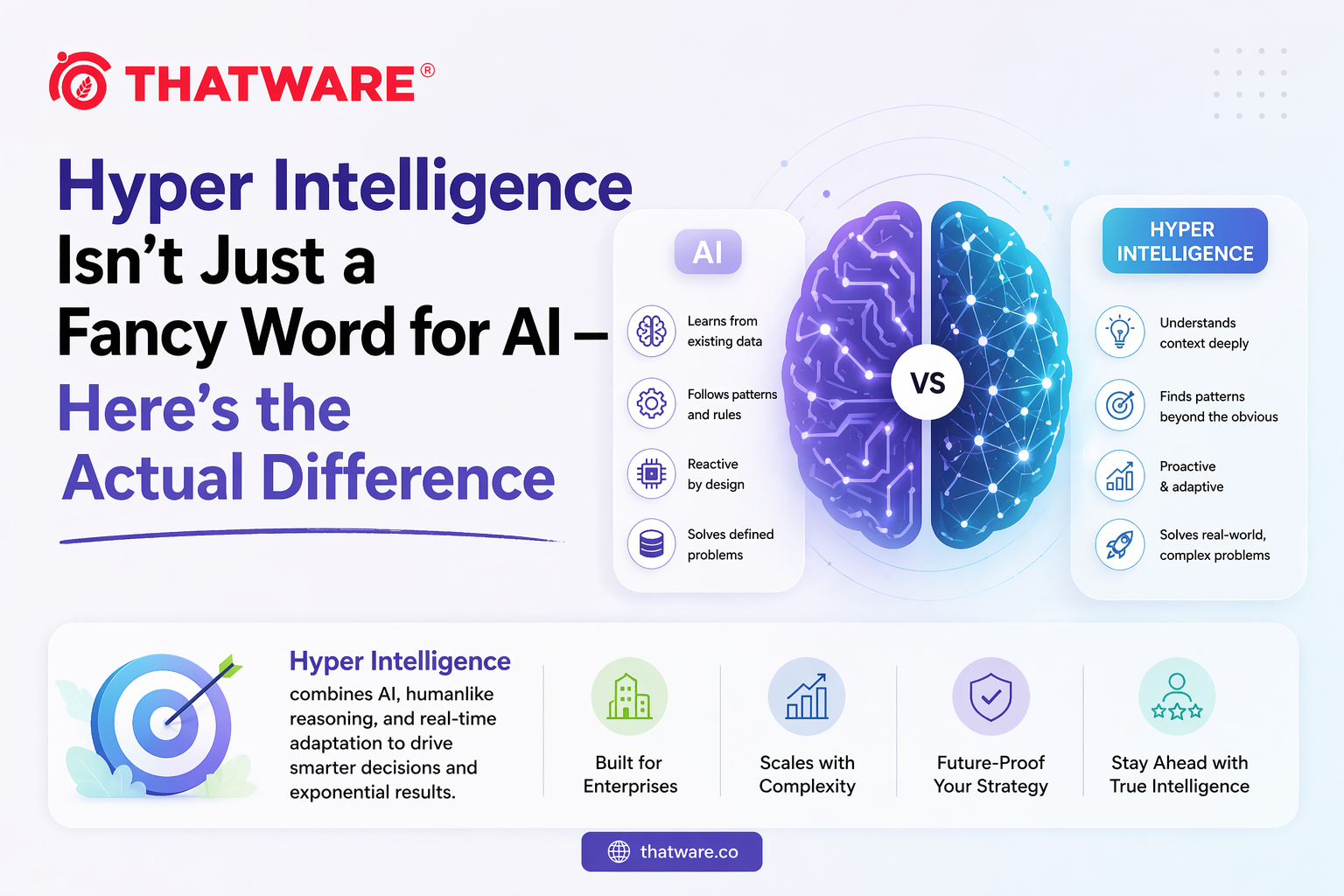
There’s a thing that happens in tech where a genuinely meaningful concept gets buried under marketing language until it’s hard to know if the concept was ever real or just a brand exercise. “Hyper intelligence” is at risk of that. Which is a shame, because the actual idea behind it is worth understanding — especially if you’re trying to make sense of where SEO is heading.
So let’s just lay it out plainly. What is hyper intelligence? And why does it matter for how content gets found, evaluated, and ranked in 2026?
AI Is a Tool. Hyper Intelligence Is a System.
Most people think of AI as a thing you use — a tool that generates text, analyzes data, recognizes images, translates language. That’s accurate but incomplete. Individual AI models are powerful but narrow. A language model knows a lot about language. A vision model knows about images. They don’t inherently know about each other, or about the broader context of a decision being made.
Hyper intelligence refers to something different: the coordination of multiple AI systems, data sources, and cognitive models into a unified decision-making layer that can reason across domains simultaneously. It’s not a single model being smarter — it’s an architecture that synthesizes inputs from many sources and produces output with a kind of contextual awareness that narrow AI can’t replicate.
Think of it as the difference between one brilliant specialist and a team of specialists who can actually talk to each other in real time.
Why That Distinction Matters for Search
Google and other search engines have been moving toward hyper intelligent evaluation of content for years, even if they didn’t use that terminology. The shift from keyword matching to semantic understanding, then to entity recognition, then to intent modeling, then to AI Overviews — each step was a move toward systems that synthesize multiple signals rather than evaluating them in isolation.
What that means for SEO is significant. Content that was optimized for a single signal — keyword density, or backlink count, or page speed — performs less well in a world where the evaluation system is looking at everything simultaneously. The optimization target has changed. You’re not trying to satisfy a checklist anymore. You’re trying to create content that performs well inside a hyper intelligent evaluation system that understands context, credibility, intent, and meaning all at once.
hyperintelligence seo services are built around this understanding. They don’t optimize for individual signals in isolation — they think about how content signals interact and how the evaluation system experiences the totality of a page, a site, a brand presence. That’s a fundamentally different approach, and it produces different results.
What Hyper Intelligence Looks Like in Practice
Let’s get specific. A traditional SEO approach might look like this: pick a keyword, create content that covers the topic, build backlinks, optimize technical elements, track ranking. Each step has its own metric and its own process.
A hyper intelligence-informed approach asks different questions. What entities is this content about, and how are those entities connected to related concepts? What kind of user would search for this, at what stage of their decision process, and what would constitute a genuinely satisfying answer? How does this content fit into the larger topical ecosystem of the site? How do language models interpret this page when they’re generating summaries or AI overviews?
These aren’t new questions exactly — good SEO practitioners have always thought about them. But hyper intelligence tools and frameworks make it possible to model and optimize for them at a scale and precision that wasn’t available before.
The Human Side of the Equation
Here’s something that gets underplayed in discussions about AI and hyper intelligence: it doesn’t make human judgment irrelevant. It changes what human judgment is applied to.
When systems can handle signal analysis, pattern recognition, and data synthesis at scale, human strategists get freed up to focus on the things that are genuinely hard for machines — creative decisions, brand voice, understanding audience nuance, building real relationships in an industry. The human contribution becomes more valuable, not less, when the mechanical parts get automated well.
Good HI SEO services understand this balance. The technology handles the complexity at scale. The humans set the strategic direction and make the calls that require genuine contextual wisdom. Neither alone is enough.
Why Most Agencies Haven’t Caught Up Yet
The honest answer is that building hyper intelligent SEO infrastructure requires investment in data architecture, tool integration, and multi-model AI coordination that most agencies haven’t made. It’s easier and more financially predictable to sell the same service package that’s been working for years.
There’s also a knowledge gap. Understanding how multiple AI systems interact, how to feed them the right data, and how to interpret their outputs requires a kind of cross-disciplinary fluency — part data science, part linguistics, part search engineering — that’s genuinely rare.
The gap between agencies that have made this investment and those that haven’t is going to show up increasingly in client results over the next couple of years. Search is getting more complex. Evaluation systems are getting more sophisticated. The approaches that worked in 2020 are working less well in 2026, and that trend is going to continue.
What to Actually Look for
If you’re evaluating whether a provider genuinely operates with hyper intelligence principles or is just using the term loosely, ask these questions. How do you model entity relationships in content strategy? What AI systems do you use in combination and how do they communicate? How does your optimization approach account for AI-generated search results, not just traditional rankings?
Vague answers to those questions are a red flag. Concrete methodological answers — even if they don’t share every proprietary detail — suggest real capability.
The term “hyper intelligence” is getting used loosely. The underlying concept isn’t. Understanding the difference is worth your time.